Ground improvement in Fort Wayne encompasses a specialized suite of geotechnical engineering techniques designed to enhance the mechanical and hydraulic properties of native soils, rendering them capable of supporting structural loads and resisting settlement without the need for deep foundations. This category is critical for the region, where variable subsurface conditions often pose significant challenges to construction, driving demand for cost-effective and reliable solutions that mitigate risk and ensure long-term performance of infrastructure. By modifying in-situ ground characteristics, engineers can transform otherwise marginal sites into viable building platforms, directly impacting the feasibility and economics of commercial, industrial, and residential development across Allen County.
The local geology of Fort Wayne is dominated by glacial deposits from the Wisconsinan stage, resulting in a complex stratigraphy of till, outwash sands and gravels, and glaciolacustrine clays and silts. These soils frequently exhibit loose to medium-dense granular layers prone to settlement under load, alongside soft, compressible cohesive strata that can consolidate over decades. The presence of a shallow groundwater table, typical of the Maumee River basin, further complicates excavation and foundation work, making dewatering difficult and increasing the risk of liquefaction in saturated sands during seismic events. This inherent variability demands thorough site investigation and tailored ground improvement strategies to address specific weaknesses such as low bearing capacity, excessive total and differential settlement, and poor drainage.
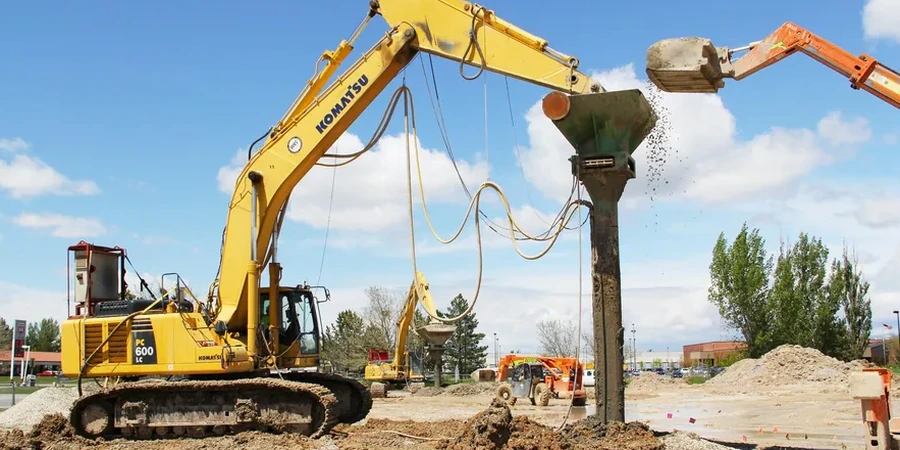
Design and execution of ground improvement in the United States are governed by national standards that directly apply to Fort Wayne projects. The primary reference is the International Building Code, adopted by the State of Indiana, which mandates that foundation and soil improvement designs meet the requirements of ASCE 7 for load combinations and performance criteria. Geotechnical investigations must follow ASTM D1586 for Standard Penetration Tests and ASTM D2487 for soil classification, while specific improvement methods adhere to guidelines from the Federal Highway Administration (FHWA), particularly manuals like Ground Improvement Methods (FHWA-NHI-16-027) which supply detailed design methodologies for techniques such as stone column design and rigid inclusions. Quality control is paramount, with verification testing often specified via ASTM D4719 for pressuremeter tests or ASTM D1143 for deep foundation load tests adapted for improved ground.
The types of projects in Fort Wayne that routinely require ground improvement are diverse, reflecting the city's ongoing expansion and infrastructure renewal. Large-footprint commercial structures, such as distribution centers and retail complexes, often rely on vibrocompaction design to densify loose granular fills and natural sands, preventing unacceptable settlement under heavy floor loads. Roadway embankments and bridge approaches over compressible river deposits utilize wick drains combined with surcharging to accelerate consolidation, while municipal facilities like water treatment plants on former industrial or floodplain sites demand mass stabilization to address heterogeneous fill and soft organic silts. Additionally, urban infill projects on previously undeveloped parcels with thick clay layers frequently specify stone columns to supply both reinforcement and drainage, ensuring stable foundations for mid-rise structures.
Available services
Quick answers
What are the primary benefits of ground improvement over traditional deep foundations?
Ground improvement treats the soil mass in place, often eliminating the need for costly driven piles or drilled shafts. Benefits include reduced concrete and steel consumption, lower carbon footprint, faster installation, and the ability to support ground-bearing slabs directly. It also mitigates total and differential settlement across a site, providing a uniform response that protects structural integrity and serviceability.
How do I know if my Fort Wayne site requires ground improvement?
A comprehensive geotechnical investigation is the first step. Indicators include Standard Penetration Test (SPT) N-values below 10 in granular soils, undrained shear strengths under 1,000 psf in clays, or predicted settlement exceeding 1 inch under design loads. The presence of undocumented fill, high groundwater, or a history of settlement in adjacent structures also strongly suggests the need for engineered improvement.
Which ground improvement method is best for loose, sandy soils with a high water table?
For loose sands and gravels below the water table, vibrocompaction is highly effective. A depth vibrator densifies the grain matrix, increasing relative density and shear strength while reducing liquefaction potential. The process is rapid, leaves no spoil, and is ideal for improving large areas under warehouses, pavements, and embankments where settlement control is the primary concern.
What role does quality control testing play in a ground improvement project?
Quality control is non-negotiable and validates the design assumptions. Post-treatment testing, such as cone penetration tests (CPT), pressuremeter tests, or load tests on individual elements like stone columns, measures the achieved improvement. This data confirms that acceptance criteria for bearing capacity, modulus, and settlement have been met, providing documented assurance to owners and regulatory authorities.