In Fort Wayne, the term 'slopes' encompasses far more than a simple incline on a property. It refers to the critical engineering discipline of analyzing, designing, and stabilizing natural and man-made earthen inclines to prevent failure and ensure long-term safety. Whether it's the gentle banks along the St. Marys or Maumee rivers, the steep cuts created for new roadway expansions like the ongoing I-69 corridor improvements, or the embankments supporting commercial developments near the Dupont Road retail corridor, the stability of these slopes is paramount. A comprehensive approach to slopes integrates subsurface investigation, hydrologic assessment, and structural reinforcement to manage the risks of erosion, landslides, and soil creep that can threaten infrastructure, property, and public safety.
The local geology of Fort Wayne presents a unique set of challenges that make professional slope evaluation essential. The city is situated in a region shaped by Pleistocene glaciation, characterized by a complex stratigraphy of glacial till, outwash sands and gravels, and lacustrine silts and clays. These soils are often heterogeneous and can be highly erodible when exposed to water. The relatively flat topography of the Great Lakes Plain is punctuated by river valleys, where the most significant and potentially unstable slopes are found. The presence of a shallow groundwater table, particularly in areas near the confluence of the city's three rivers, is a primary trigger for slope instability, as increased pore water pressure can dramatically reduce soil shear strength. A thorough slope stability analysis must account for these local soil behaviors and drainage patterns to accurately predict performance.
Regulatory compliance is a non-negotiable aspect of any slope-related project in Fort Wayne. All work must adhere to the Allen County Soil and Water Conservation District standards and the Indiana Storm Water Quality Manual, which mandate erosion and sediment control measures for any land-disturbing activity. For critical infrastructure and public safety projects, the design and construction of earth slopes and retaining structures must conform to the Indiana Department of Transportation (INDOT) Standard Specifications, which reference national geotechnical standards from AASHTO and FHWA. These regulations dictate the required factors of safety for global stability, allowable settlement, and the design life of mitigation measures. For residential and commercial developments, the Fort Wayne Department of Planning solutions enforces the local zoning ordinance and building code, which adopts the International Building Code (IBC) with Indiana amendments, requiring geotechnical investigations where slope hazards are identified.
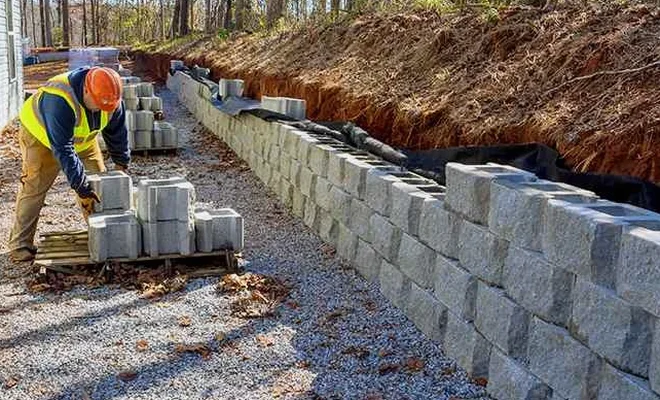
The application of slope engineering in Fort Wayne is diverse, spanning public infrastructure, commercial development, and residential projects. Transportation projects frequently require the design of stabilized embankments and mechanically stabilized earth (MSE) systems for bridge approaches and highway overpasses. A robust retaining wall design is often the central element in these scenarios, providing the necessary lateral support to create usable space or protect roadways from slumping. Commercial sites, such as the sprawling retail centers off Lima Road, often need to manage grade changes for parking lots and building pads, necessitating engineered cut-and-fill slopes. Even residential construction on the city's expanding northwest fringe, where builders encounter gently rolling terrain, benefits from a basic stability assessment to prevent future foundation issues or yard loss due to erosion. Each project type demands a tailored solution that balances cost-effectiveness with long-term resilience against Indiana's freeze-thaw cycles and seasonal precipitation patterns.
Available services
Quick answers
What are the most common signs of a failing slope in Fort Wayne?
Common indicators of slope instability include new or widening cracks in the ground, particularly parallel to the top of the slope; tilting or movement of fences, walls, and trees; the formation of small, stepped-off scarps; and areas of persistent soil saturation or seeping water. In Fort Wayne's glacial soils, bulging at the toe of a slope is a critical warning sign of a potential deep-seated rotational failure.
How do local soil conditions in Fort Wayne influence slope stability?
Fort Wayne's soils are predominantly glacial deposits, creating a layered system of clays, silts, and sands. The fine-grained tills can lose significant strength when saturated, while sand and gravel layers can transmit water rapidly, leading to internal erosion and piping. The high water table near the river corridors is a dominant factor, and the heterogeneity of these deposits means a site-specific geotechnical investigation is always required for accurate analysis.
What is the difference between a global stability failure and a surficial erosion failure?
A global stability failure involves a deep-seated rotational or translational movement of a large soil mass along a shear surface, threatening entire structures and requiring major remediation like a retaining wall. Surficial erosion is the gradual removal of soil particles from the slope face by wind and water, which, while less catastrophic initially, can steepen a slope over time and eventually trigger a deeper failure. Both issues are prevalent in Fort Wayne's climate.
When is a retaining wall required instead of a simple graded slope?
A retaining wall becomes necessary when space constraints prevent a slope from being graded to a stable, flatter angle, or when a nearly vertical grade change is needed to maximize usable land. This is common on tight urban lots, for roadway widening projects, or to support bridge abutments. The design must consider lateral earth pressures, drainage behind the wall, and a stable global condition, all governed by INDOT and IBC standards.