The mistake we see contractors make in Fort Wayne isn't skipping the CBR test entirely—it's running a CBR on a sample that doesn't represent the actual subgrade. You compact a borrow material to 95% Modified Proctor, run a soaked CBR, get a value of 15 or 20, and design your pavement section accordingly. Then spring arrives. The native silty clay beneath the prepared subgrade—the stuff that covers half of Allen County—saturates from snowmelt and loses bearing capacity. The pavement fails not because the CBR was wrong, but because the sample didn't match what's actually down there. Our laboratory handles this by pairing the test with a grain size analysis to confirm the material matches the project's subgrade profile. For new construction, we also recommend correlating results with field density testing so the structural section isn't undermined by compaction variability.
Designing a Fort Wayne pavement without a soaked CBR is like assuming it won't rain for the next 20 years. The subgrade will eventually saturate, and the test needs to reflect that.
Our approach and scope
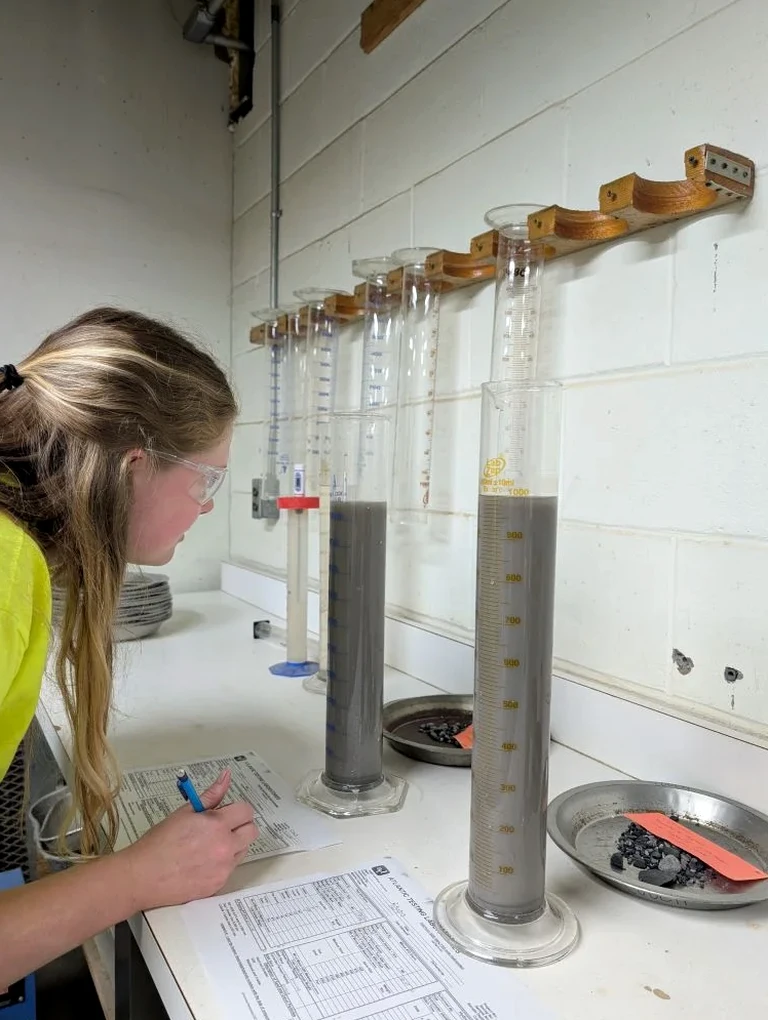
Local geotechnical context
Fort Wayne's freeze-thaw cycles are brutal on pavement sections that weren't designed with a realistic subgrade strength value. The average winter sees the ground freeze to a depth of about 30 inches, and when that frozen layer thaws from the top down in March, water gets trapped between the pavement structure and the still-frozen subgrade below. A soaked CBR value that looked acceptable in the lab at 6 or 7 can drop below 2 under these saturated, confined conditions. The pavement pumps fines up through the base course, voids form beneath the asphalt, and potholes appear by April. This isn't speculation—it's the mechanism behind most premature failures on secondary roads and parking lots across northeastern Indiana. Running the CBR at multiple moisture contents, including fully soaked, gives the design engineer the data needed to specify a thicker aggregate base or a stabilization treatment that prevents the subgrade from reaching that critical saturation threshold. When the site is near a flood-prone reach of the Maumee River, we also recommend evaluating in-situ permeability to anticipate how quickly the subgrade will respond to seasonal high water.
Video resource
Reference standards
The testing protocol follows ASTM D1883-21, AASHTO T 193-22, and compaction references ASTM D698/D1557, in accordance with the AASHTO Guide for Design of Pavement Structures (1993).
Complementary services
Soaked CBR (ASTM D1883)
Three-point compaction with 96-hour soaking, reported at 0.1 and 0.2 inch penetration. We include the complete load-penetration curve and the swell percentage during soaking.
Unsoaked CBR for Granular Layers
For base and subbase materials where saturation isn't the controlling condition. Run at the specified density and moisture content, typically 95% of Modified Proctor.
CBR with Lime/Cement Stabilization
We prepare specimens with the proposed additive dosage, cure them for the specified period, and then run the soaked CBR to verify the strength gain before the mix reaches the field.
Subgrade Resilient Modulus Correlation
Using the AASHTO MEPDG correlation equations, we convert the soaked CBR to a resilient modulus for use in mechanistic pavement design software, saving you the cost of separate triaxial resilient modulus testing.
Typical parameters
Quick answers
What does a laboratory CBR test cost in Fort Wayne?
Why is the soaking period 96 hours for Fort Wayne projects?
The 96-hour soaking period specified in ASTM D1883 simulates the worst-case saturated condition a subgrade will background over the pavement's design life. In Fort Wayne, where the water table is shallow along the river corridors and snowmelt saturates the upper soil profile every spring, this four-day soak is the minimum needed to represent real conditions. Shortening it produces an unconservative CBR value.
Can you test samples from any borrow source in the Fort Wayne area?
Yes. We test samples from any borrow pit, on-site cut, or imported fill source in Allen County and surrounding areas. The key is that the sample must be representative of the material that will actually be compacted as subgrade. We supply sampling guidance to make sure the material we test in the lab matches what the grading contractor places in the field, and we can coordinate with field density testing to close the loop between lab design and construction QC.