The legacy of the Maumee River basin and retreating Wisconsinan glaciers left Fort Wayne with a complex stratigraphy of soft lacustrine clays and silts over dense till. When a structure must rise on these compressible zones—say within the redeveloping corridors near the confluence of the St. Joseph and St. Marys—traditional shallow footings often fail to meet differential settlement criteria. Stone column design becomes the practical pathway to transfer loads through weak strata while providing a controlled drainage network. Our approach integrates site-specific CPT testing to map the undrained shear strength profile with centimeter-scale precision, and we correlate those cone resistances with grain-size analysis of the aggregate source to ensure the stone matrix locks correctly under confinement.
Stone columns in Fort Wayne do more than reinforce—they create a vertical drainage path that accelerates consolidation of the soft clays by a factor of three to five.
Our approach and scope
For sites where the clay contains organic lenses or thin peat seams, we adjust the area replacement ratio upward and may recommend a preloading phase with settlement monitoring. The column layout is never generic; it is shaped by the actual stratigraphy logged from mud-rotary borings and supplemented by seismic refraction profiles that identify buried bedrock valleys where depth to till can change abruptly. This dual-method reconnaissance prevents the costly mistake of designing uniform-length columns across a highly irregular bearing surface.
Local geotechnical context
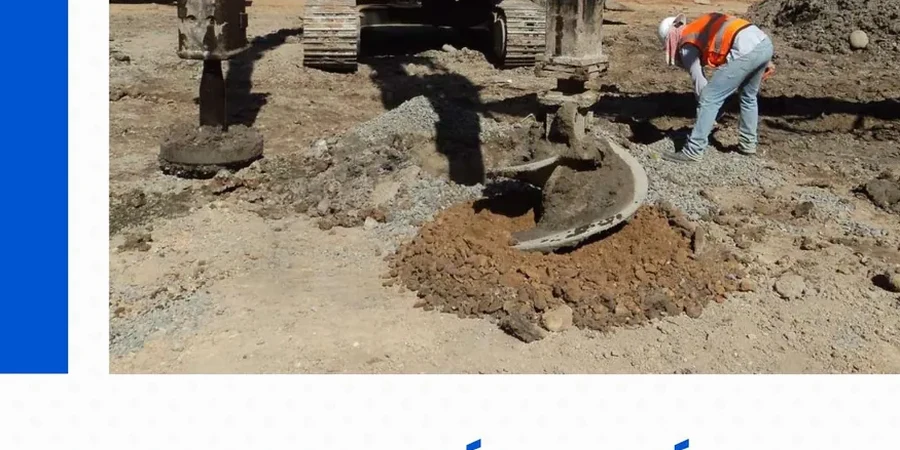
The vibro-replacement rig used on Fort Wayne projects operates with a 175-horsepower power pack driving a poker vibrator that displaces soil laterally while stone is fed from the hopper. The risk in this city’s ground is not refusal but the opposite: uncontrolled lateral displacement into the soft, sensitive clay can heave adjacent footings or rupture shallow utilities if the column sequence is not planned with a stiff perimeter first. Our field team installs two initial columns at opposite sides of the grid and measures pore pressure response with a standpipe piezometer before proceeding. The biggest structural vulnerability is column punching into a thin crust over a very soft layer—a condition that our design catches by requiring a minimum crust thickness-to-column-diameter ratio before the standard bearing capacity equations are applied.
Reference standards
ASTM D2487 Standard Practice for Classification of Soils for Engineering Purposes (Unified Soil Classification System), ASTM D1586 Standard Test Method for Standard Penetration Test (SPT) and Split-Barrel Sampling of Soils, ASCE/SEI 7 Minimum Design Loads for Buildings and Other Structures (Chapter 20: Site Classification), AASHTO LRFD Bridge Design Specifications, Section 10: Foundations, and FHWA-NHI-14-006 Ground Improvement Methods, Volume I.
Complementary services
Subsurface investigation & lab testing
Mud-rotary borings with SPT at 2.5-foot intervals, thin-wall Shelby tube sampling in the soft clay zone, and laboratory triaxial UU and consolidation tests to establish the undrained shear strength and compression index for Priebe analysis.
Stone column design & settlement analysis
Calculation of the area replacement ratio, column spacing, and length using finite-layer settlement modeling. Load distribution between column and native soil is checked for both serviceability and ultimate limit states.
Construction monitoring & load testing
Full-time field observation during installation, including column diameter verification, stone volume reconciliation, and post-installation modulus verification using a zone load test with settlement plates.
Typical parameters
Quick answers
What stone column diameter and spacing are typical for Fort Wayne’s soft clay?
For the lacustrine clays common in Fort Wayne, we typically design columns 30 to 36 inches in diameter on a triangular grid of 5 to 8 feet center-to-center spacing, achieving an area replacement ratio between 12 and 18 percent. The exact layout is tuned to the consolidation settlement target and the undrained shear strength measured from triaxial UU tests.
How much does a stone column design package cost for a commercial building in Fort Wayne?
Can stone columns be installed close to existing buildings in Fort Wayne's urban lots?
Yes, with careful sequencing. We start with a perimeter row of columns installed at a reduced vibration amplitude, and we monitor lateral displacement with inclinometer casings if the adjacent structure is within 15 feet. The vibro-replacement process can be adjusted to a bottom-feed method to minimize ground disturbance in tight spaces.