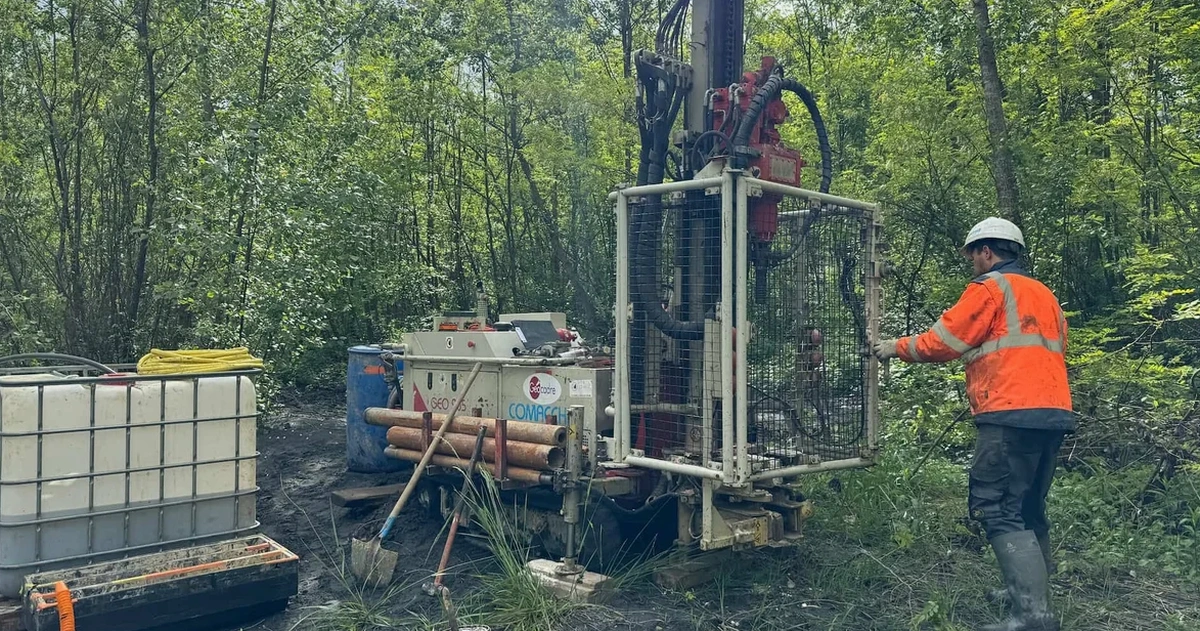
Builders working in Fort Wayne know the drill: a site near the St. Joseph River in the 46802 zip behaves nothing like a lot out southwest by Aboite Township. The river corridor brings layers of alluvial silt and sand that shift with the water table, while the glacial till uplands can hide stiff clay lenses that look solid until you run a triaxial test. A thorough soil mechanics study bridges that gap. We tie field observations from test pits to lab index work like grain size and Atterberg limits, then feed the numbers into bearing capacity and settlement models. For Fort Wayne, where freeze-thaw cycles chew through poorly drained subgrades, the lab data drives decisions on overexcavation depth and compaction specs.
Glacial lake plain clays in Fort Wayne can lose half their undrained shear strength when remolded — lab testing catches what a blow count misses.
Our approach and scope
Local geotechnical context
One thing we see over and over in Fort Wayne: a site gets cleared, topsoil stripped, and the exposed clay looks dry and stiff. The contractor pours footings. Two wet seasons later, the floor slab has a half-inch crack and the driveway has pulled away from the garage. The problem isn't bearing failure — it's shrink-swell in the upper weathered zone. Fort Wayne's glacial clays can have a plasticity index above 25, which puts them squarely in the high-expansion category per IBC Table 1808.8.2. A soil mechanics study that skips Atterberg limits and moisture-density relationships misses the whole story. We also check for undocumented fill — old farm ponds and demolition debris buried under a thin cap of topsoil. That material consolidates unevenly and wrecks slab-on-grade performance within five years.
Reference standards
The geotechnical investigation references ASTM D2487-17 for Unified Soil Classification, ASTM D4767-11 for Consolidated-Undrained Triaxial testing, IBC 2021 Chapter 18 for Soils and Foundations, AASHTO T-99/T-180 for Moisture-Density Relations, and ASCE 7-22 for Minimum
Complementary services
Residential Foundation Investigation
Two to four test pits or SPT borings, Atterberg limits, Proctor curve, and a bearing capacity letter sealed by our engineer. Sized for single-family homes, additions, and pole barns across Allen County.
Commercial Building Geotechnical Package
Deep borings through the glacial sequence, triaxial and consolidation testing, lateral earth pressure parameters, and a full report with shallow and deep foundation alternatives. Typical for multi-story and tilt-up construction.
Pavement Subgrade Evaluation
CBR and resilient modulus correlations from Proctor and grain-size data, plus drainage recommendations for parking lots and access roads where frost heave is the controlling failure mode.
Typical parameters
Quick answers
How much does a soil mechanics study cost for a single-family lot in Fort Wayne?
Why does Fort Wayne's glacial geology matter for my foundation design?
Fort Wayne sits on a mix of glacial lake plain deposits, end moraines, and outwash channels. The lake plain clays are normally consolidated and compressible, meaning they settle more under load than the stiffer till found in the western parts of the city. A soil mechanics study identifies which unit you're building on and gives the engineer the right settlement parameters.
What lab tests are included in a standard Fort Wayne soil mechanics study?
A standard package includes moisture content, Atterberg limits, grain-size distribution by sieve and hydrometer, Standard Proctor compaction, and unconfined compression. For commercial projects we add one-dimensional consolidation and consolidated-undrained triaxial shear tests.
How long does the lab testing phase take?
Basic index tests return results in three to five business days. Consolidation and triaxial tests take longer — typically seven to ten business days — because they require multi-stage loading and pore pressure equalization. We schedule lab work to overlap with field drilling so the report timeline stays tight.