Fort Wayne sits at the confluence of three rivers on a bed of glacial till and outwash deposits that challenge even modest grade changes. The freeze-thaw cycles common to northeastern Indiana subject any retaining wall design to lateral earth pressures that shift with the seasons. We approach each Fort Wayne project by first characterizing the native silty clays and sand lenses through subsurface investigation, then matching the wall type — gravity, cantilever, or mechanically stabilized earth — to the actual soil parameters measured on site. This avoids the overdesign that generic assumptions force and keeps construction budgets reasonable. For taller walls near the Maumee River floodplain, we combine our retaining wall design with a slope stability analysis when the retained cut exceeds 12 feet or when backslope geometry raises concerns about global failure surfaces extending beyond the wall footprint.
A retaining wall in Fort Wayne's glacial till needs drainage designed for spring thaw, not just design-storm rainfall — frozen ground sheds water laterally into the backfill zone for weeks each March.
Our approach and scope
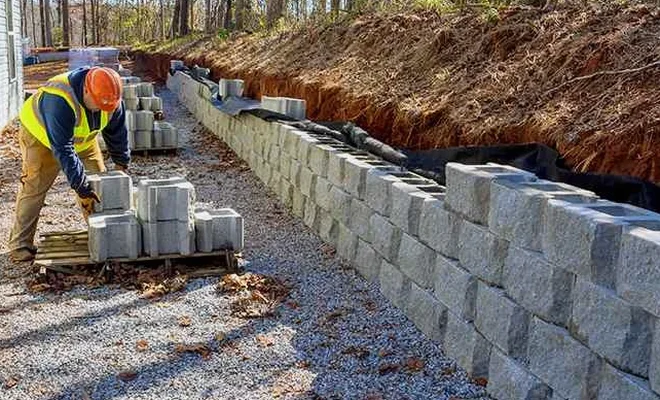
Local geotechnical context
With a population of over 265,000, Fort Wayne continues expanding residential subdivisions into areas where 8-foot basement excavations and tiered backyard retaining walls intersect weathered till profiles. The biggest risk we encounter is contractors treating a retaining wall design as a standalone element rather than part of a connected earth-structure system. A wall that performs perfectly on paper fails in the field when the uphill stormwater management is ignored or when the footer bears on disturbed fill from a prior utility trench. In one Fort Wayne commercial site near I-69, a 14-foot MSE wall began tilting within two seasons because the designer used textbook friction values for dense sand — but the actual backfill was a silty sand with 28 percent fines that lost strength when saturated. Our approach mandates compaction testing of the wall backfill and verification of foundation bearing strata before the first block is placed, reducing the rework risk that erodes project margins.
Reference standards
The retaining wall design in Fort Wayne adheres to IBC 2021 Chapter 18 on Soils and Foundations, AASHTO LRFD Bridge Design Specifications (9th Edition, Section 11), ASCE 7-22 for Minimum Design Loads, ASTM D3080 for the Direct Shear Test of Soils Under Consolidated Drained Conditions, and FHWA-NHI-10-024 for the Design and Construction of Mechanically Stabilized Earth Walls.
Complementary services
Subsurface Investigation for Wall Foundations
Rotary wash borings and CPT soundings to map bearing stratum depth, groundwater level, and lateral variability across the wall alignment.
Structural Wall Design & Analysis
Gravity walls, cantilever reinforced concrete, and MSE systems designed per AASHTO LRFD with global stability verification using limit equilibrium methods.
Drainage & Backfill Specification
Granular drainage columns, filter fabric selection, and weephole detailing calibrated to Fort Wayne's freeze-thaw depth of 36 inches.
Construction Phase Observation
Field verification of foundation bearing conditions, backfill compaction testing, and as-built geometry checks against design tolerances.
Typical parameters
Quick answers
What type of retaining wall is most cost-effective for a 6-foot grade change in Fort Wayne?
For a 6-foot retained height, a segmental block gravity wall using local crushed limestone backfill is typically the most economical option in Allen County. The blocks are manufactured regionally which keeps material freight costs low. If the wall must support a driveway or patio surcharge within 5 feet of the face, we shift to a reinforced cantilever design — the added steel and concrete cost is offset by avoiding long-term settlement and rotation claims. We can supply a comparative cost-benefit table during the feasibility phase once we have the subsurface data.
Do retaining walls in Fort Wayne require a building permit?
Yes — the Allen County Building Department requires a permit for retaining walls exceeding 4 feet in height measured from the bottom of the footing to the top of the wall. Walls over 6 feet tall, or any wall supporting a surcharge from a structure, require sealed engineering drawings. Our design package includes the stamped calculations and construction details that the permit office expects, which typically accelerates the review process by one to two weeks compared to incomplete submittals.
How much does a retaining wall design cost for a residential project in Fort Wayne?
How do you handle the high groundwater table near Fort Wayne's rivers in wall design?
The Maumee, St. Marys, and St. Joseph river corridors create perched water conditions in the overbank silts that persist well into spring. We install standpipe piezometers during the investigation phase to measure the seasonal high groundwater elevation. The wall design then incorporates a continuous toe drain with positive outlet, a free-draining chimney drain behind the wall face, and in some cases a bentonite-soil cutoff to intercept lateral seepage before it reaches the backfill zone. Hydrostatic pressure behind a wall is the leading cause of premature failure in this region, so drainage redundancy is built into every design.