Fort Wayne developed at the confluence of three rivers, and that fluvial history defines everything we encounter below grade. The downtown grid sits on terraced alluvium over Wisconsinan glacial till, while the suburban fringes to the north and west transition into lacustrine plain deposits with compressible silt lenses that can extend twenty feet deep. When a structural engineer needs continuous stratigraphic resolution for shallow foundations near the St. Marys River, conventional split-spoon sampling often misses the thin drainage layers that control consolidation rate. We run the cone penetration test because it captures those decimeter-scale transitions without disturbing the material, giving us a near-continuous profile of tip resistance and sleeve friction. In Fort Wayne, where the water table typically sits within six to eight feet of grade, we also collect pore pressure dissipation data to estimate in-situ permeability—critical for any excavation support design. Contractors we work with regularly pair CPT data with test pits to ground-truth the stratigraphy visually at accessible locations before committing to a full borings program.
A continuous cone profile through Fort Wayne's layered alluvium reveals thin drainage seams that split-spoon sampling misses entirely—and those seams dictate how fast the site consolidates.
Our approach and scope
Local geotechnical context
One pattern we have learned working Fort Wayne sites over multiple seasons is that the alluvial clay layers along the Maumee River corridor are not as homogeneous as older county soil surveys suggest. We have logged soundings where a stiff desiccated crust sits over normally consolidated silty clay with undrained shear strength values dropping by half within four vertical feet. If the design team assumes a single strength envelope from a few SPT blows in the upper crust, the foundation can be undersized for the real bearing condition at depth. The cone picks up that strength degradation continuously, and the friction ratio shifts visibly as the soil transitions from overconsolidated to normally consolidated behavior. We also watch for elevated pore pressure response in the silt seams, since those layers can act as drainage barriers during construction dewatering. In the northeastern part of the county, where glacial outwash sands overlie the till, liquefaction screening using CPT-based cyclic resistance methods provides a much cleaner trigger curve than SPT-based correlations for the fine sands typical of the region.
Reference standards
ASTM D5778-20: Standard Test Method for Electronic Friction Cone and Piezocone Penetration Testing of Soils; ASTM D6067/D6067M-17: Standard Practice for Using the Electronic Piezocone Penetrometer for Environmental Site Characterization; Robertson (2016): Cone
Complementary services
Piezocone Penetration Testing (CPTu)
Full u2 pore pressure measurement during penetration with dissipation tests at target depths. We deliver corrected cone resistance profiles, friction ratio plots, and SBTn soil behavior type classification using the Robertson (2016) normalized charts. This is our standard specification for foundation design and liquefaction assessment in Allen County.
Seismic Cone Penetration Testing (SCPTu)
Downhole shear wave velocity measurement integrated with the cone sounding. A triaxial geophone module acquires Vs at one-meter intervals during rod breaks, providing site classification per ASCE 7-22 directly from measured wave speeds rather than correlation tables. Particularly useful for seismic site class determination on Fort Wayne projects governed by IBC Chapter 16.
Typical parameters
Quick answers
How much does CPT testing cost in Fort Wayne?
How deep can CPT soundings go in Fort Wayne soils?
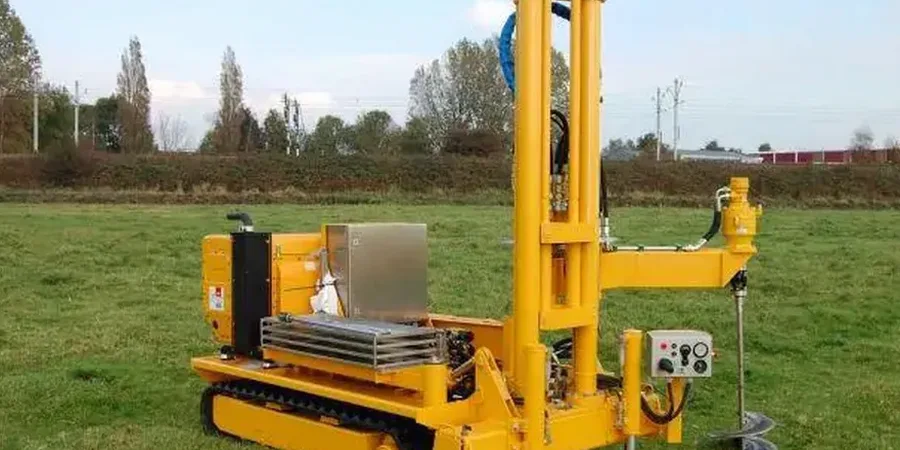
Depth varies significantly by location. In the alluvial deposits along the St. Joseph and Maumee corridors, fifteen to eighteen meters is typical before encountering dense glacial till that approaches refusal for our twenty-ton rig. South of the city, where the till is thinner and weathered shale bedrock lies shallower, soundings may stop at eight to twelve meters. We monitor push force continuously and advise if the cone hits refusal before the planned target depth.
What soil parameters can you derive from CPT data for foundation design?
From a single CPTu sounding we derive undrained shear strength for clays, relative density and friction angle for sands, constrained modulus for settlement calculations, and preconsolidation pressure from pore pressure dissipation response. The normalized soil behavior type index allows us to classify the stratigraphy without physical samples. For Fort Wayne's interbedded alluvium, these continuous profiles let us identify the strongest bearing layer and the weakest compressible zone in the same vertical log.
Do you need soil borings alongside CPT, or can CPT replace them?
CPT provides continuous geomechanical data but does not recover physical samples for visual classification or laboratory testing. For Fort Wayne projects where the stratigraphy is already well-understood from prior geotechnical reports in the neighborhood, we often run CPT as the primary investigation tool with one or two verification borings. On greenfield sites with no nearby reference data, we recommend combining CPT soundings with at least one sampled boring to calibrate the soil behavior type classification against actual material from the site.