Fort Wayne sits on glacial deposits that vary from dense till to soft lacustrine clays, and ASCE 7 requires a site class determination for every new structure. The 2015 National Seismic Hazard Model shows that the New Madrid and Wabash Valley seismic zones influence ground motion across Indiana, even if the return periods are long. Most local drillers report refusal on lodgement till at 15 to 30 feet, but the river valleys hide buried channels with 60 feet of soft sediment. Seismic microzonation maps those contrasts so the structural engineer does not apply a generic Site Class D when half the parcel sits on Site Class C. We run MASW lines along critical building axes to measure Vs30 directly, then calibrate results with SPT drilling at control points so the site response model reflects real stratigraphy.
A site class boundary running diagonally under the foundation is more dangerous than a uniform soft soil—microzonation catches that before steel goes in.
Our approach and scope
- MASW and MAM arrays for depth ranges from 10 to 100 feet
- Vs30 computation per NEHRP guidelines and ASCE 7-22 Chapter 20
- Integration with standard penetration test data for lithologic verification
- Site class maps at 1:500 to 1:2000 scale, ready for permit submittal
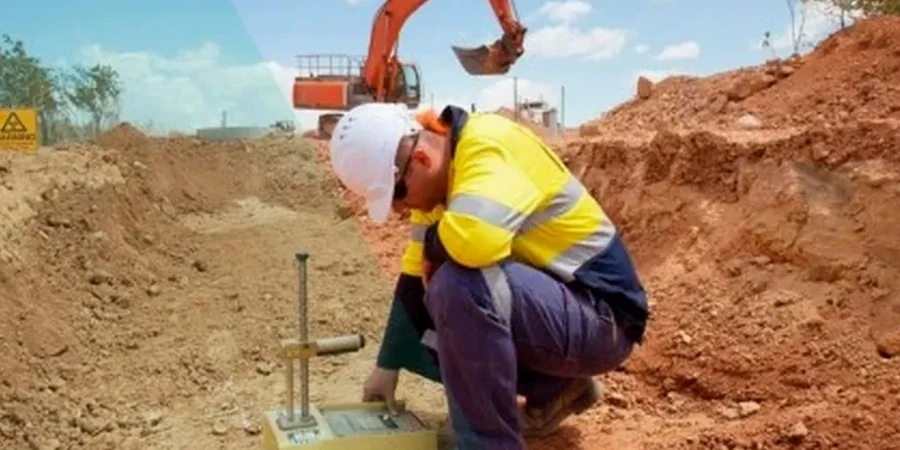
Local geotechnical context
The contrast between Fort Wayne’s well-drained tills and the saturated silts of the Maumee River floodplain creates a local amplification pattern that a regional hazard map cannot resolve. A structure designed for Site Class D on the floodplain may be overdesigned and expensive, while one assumed Class C on a buried clay lens could be unconservative. The Wabash Valley seismic zone, roughly 150 miles southwest, has produced events up to M5.8 that propagated into Allen County, and the USGS Unified Hazard Tool shows a 2% in 50-year PGA around 0.04 to 0.06 g on rock. Soft soil can double that at the surface. Microzonation identifies zones where the fundamental period of the soil column aligns with the building period, a resonance condition that drives up drift demands and can damage non-structural elements before the frame yields. Missing that pattern is a liability no geotechnical report should carry.
Reference standards
The site classification procedure follows ASCE 7-22 Chapter 20, the NEHRP Recommended Seismic Provisions (FEMA P-1051), and ASTM D4428 / D7400 standards for crosshole and downhole seismic testing.
Complementary services
Vs30 Site Classification
Active and passive surface wave testing to compute Vs30 per ASCE 7-22, with correlation to borings and CPT soundings for stratigraphic control.
Site Response Mapping
Production of site class maps at scales suitable for permit review, showing boundaries between Site Class C, D, and E where present, with contour intervals of 50 ft/s.
Typical parameters
Quick answers
How much does a seismic microzonation study cost in Fort Wayne?
What is the difference between a regional hazard map and a site-specific microzonation?
The USGS National Seismic Hazard Map gives rock motion at a reference site condition (Vs30 = 760 m/s). A site-specific microzonation measures the actual shear-wave velocity under your building and captures lateral changes across the footprint. In Fort Wayne, where glacial till can transition to soft lake clay within 100 feet, the mapped site class can shift from C to D, which changes the design spectral accelerations by 30 to 40 percent. The regional map averages that out; microzonation does not.
Do Fort Wayne building permits require a site-specific site class determination?
Allen County enforces the Indiana Building Code, which adopts ASCE 7. Chapter 20 allows a default Site Class D when no site-specific data are available, but the default carries a penalty in the form of higher design forces. Most structural engineers prefer a measured Vs30 to justify a Class C classification when the soils support it, reducing seismic load and foundation cost. For essential facilities and taller structures, the code encourages site-specific investigation, and we supply the MASW and boring data in a format ready for peer review.