We see it all the time. A crew lays down a lift, runs a compactor, and calls it good. Six months later the floor slab cracks because the fill wasn't placed at the right moisture. That call usually comes on a Tuesday morning. The Proctor test isn't paperwork. It's the number that tells your roller operator when the soil is tight enough. In Fort Wayne, where glacial till sits under most sites, that number changes block by block. A standard Proctor on silty clay might hit 108 pcf. A modified Proctor on the same material could push past 115 pcf. The difference matters when you're bearing on compacted fill. Before we run any compaction curve we often pair it with a grain size analysis to confirm the fines content, especially if the material came from an on-site borrow pit with variable stratigraphy.
A one-percent swing in moisture can drop dry density by three or four pounds per cubic foot. That's the difference between passing and failing a compaction spec.
Our approach and scope
Local geotechnical context
A warehouse project off Lima Road taught us a hard lesson about borrowed fill. The contractor imported clay from a farm field two miles away. It looked identical to the site soil. Same color. Same feel. But the Proctor curve was completely different. The borrowed material had a higher optimum moisture and a lower maximum density. The field compaction specs written for the native soil were unachievable. The contractor burned three extra days reworking lifts that would never pass. We had to stop the job, sample the import, run a new Proctor, and rewrite the acceptance criteria. That week-long delay cost more than a hundred Proctor tests ever will. If you're hauling fill across Allen County, test it before the first truck dumps.
Reference standards
ASTM D698-12 (Standard Proctor), ASTM D1557-12 (Modified Proctor), AASHTO T-99 (Standard Method C/D), AASHTO T-180 (Modified Method C/D), and INDOT Standard Specifications Section 203 are employed to govern compaction testing for quality fill.
Complementary services
Standard Proctor (ASTM D698)
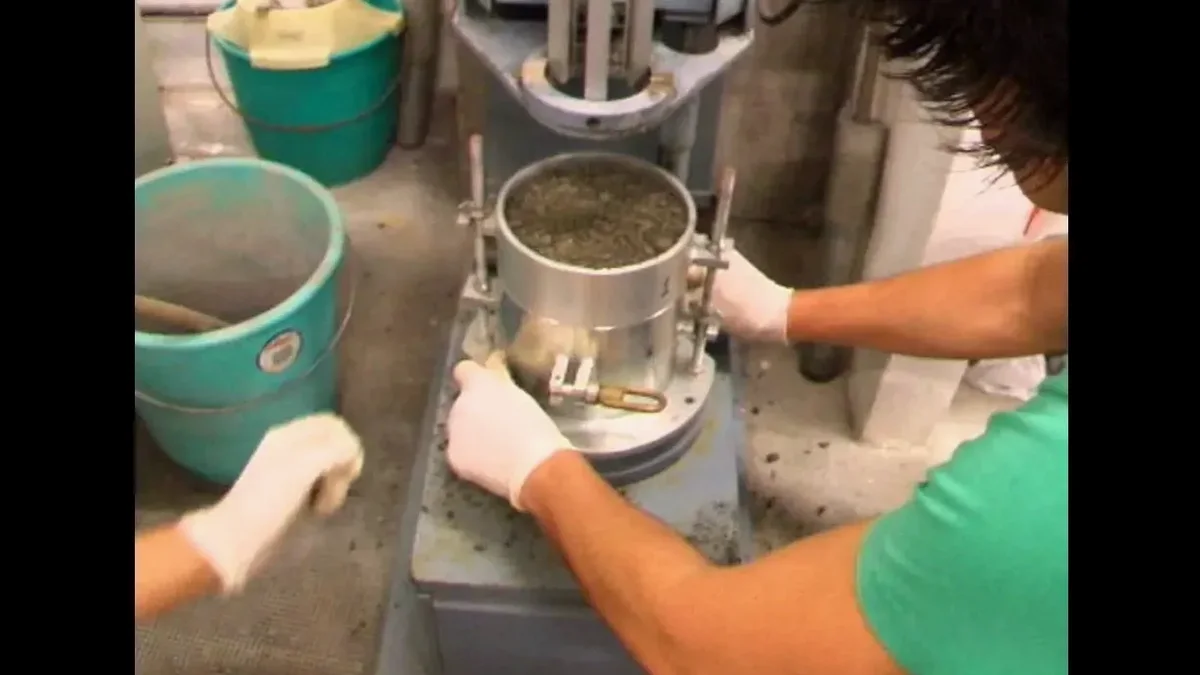
The 5.5-lb hammer, 12-inch drop method. Used for residential pads, landscaping subgrade, and low-rise commercial where compaction effort matches typical site equipment. We run Method A, B, or C depending on the fraction retained on the No. 4 sieve.
Modified Proctor (ASTM D1557)
The 10-lb hammer, 18-inch drop method. Required for INDOT highway embankments, deep utility trenches, and airport pavement subgrade. Delivers roughly 56,000 ft-lbf/ft³ of compactive effort versus 12,400 ft-lbf/ft³ for standard.
Typical parameters
Quick answers
How much does a Proctor test cost in Fort Wayne?
How long does it take to get results?
Standard turnaround is 48 hours from the time we receive the sample. We offer a 24-hour rush option for active earthwork operations where the crew is waiting on the curve. Field Proctor correlation with a nuclear gauge can be done same-day if we coordinate the sand cone calibration in advance.
Which Proctor method do I need for a project in Allen County?
It depends on the spec. Residential and light commercial under IBC usually reference ASTM D698 standard effort. INDOT projects and anything with heavy wheel loads call for ASTM D1557 modified effort. If the structural engineer hasn't specified one, we can review the loading conditions and recommend the appropriate method based on what we've seen work on similar Fort Wayne glacial till sites.