Fort Wayne sits at roughly 800 feet above sea level, spread across the Maumee River floodplain and glacial lake plains left by the Wisconsin glaciation. That glacial history left behind a layer cake of soft clays, dense till, and occasional sand lenses that can surprise anyone who assumes uniform ground. We run the Standard Penetration Test here more than any other in-situ method because it gives us a blow count and a sample in one shot—two data points that matter when you are designing footings, piles, or checking liquefaction potential. The SPT in Fort Wayne is not a routine checkbox; it is the primary tool to map how the Lake Maumee silts transition into the hard lodgement till. Before mobilizing a rig we often review existing logs from nearby borings, and for deeper profiles we may suggest pairing the work with a CPT test where continuous data fills gaps between spoon intervals.
N-values below 4 in the upper 15 feet around Fort Wayne usually mean lake clays; above 30 past 25 feet signals you hit the lodgement till.
Our approach and scope
- Split-spoon sampler recovery measured in inches after each drive
- Blow count logged in three 6-inch intervals, not just the final sum
- Soil description per ASTM D2488 performed immediately at the rig by the field engineer
- Groundwater level recorded at time of drilling and again 24 hours later when possible
Local geotechnical context
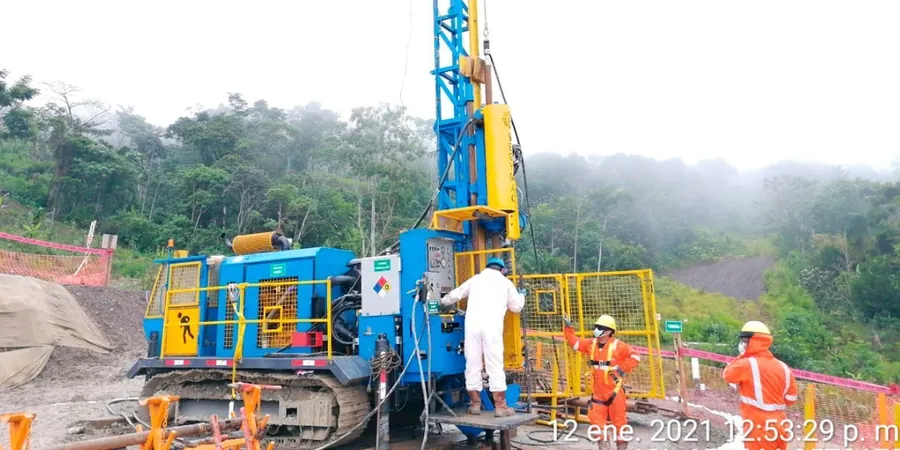
A CME-55 track rig with an automatic hammer is the machine we deploy across Allen County; it handles the glacial clays without getting stuck and delivers consistent hammer energy even when the weather turns the surface into a slick mess in March. The biggest operational risk here is not the drilling itself—it is misreading refusal. In Fort Wayne, a dense till layer can send blow counts past 50 blows per 6 inches fast. If the driller keeps hammering without recognizing practical refusal, the sample shoe deforms, the liner cracks, and the N-value becomes meaningless. Our protocol stops the test at 50 blows per 6 inches, logs refusal depth, and switches the boring to rock coring if needed. Another local hazard: sand seams within the till can collapse the hole before the spoon is retrieved, so we watch for heaving sand and adjust drilling fluid or casing on the fly. Every Fort Wayne SPT log includes refusal notation, hammer energy calibration date, and rod length corrections so the geotechnical engineer receives a workable dataset, not just a column of numbers.
Reference standards
The Standard Penetration Test in Fort Wayne, Indiana, is conducted in compliance with ASTM D1586-18, ASTM D2487, ASTM D4633, IBC Chapter 18, and ASCE 7-22.
Complementary services
Shallow SPT for Footings
Borings to 25–35 ft targeting bearing capacity and settlement analysis for spread footings in the clay crust above the till. N-values correlated to allowable bearing pressure per local Fort Wayne building department requirements.
Deep SPT for Pile Design
Extended borings to 80–100 ft through the till into the underlying bedrock. N-values used for skin friction and end bearing estimates in driven pile design, with hammer energy calibration at each site.
Liquefaction Screening SPT
SPT-based liquefaction analysis following the NCEER/Youd-Idriss method for sites near the Maumee River and its tributaries. Focus on granular layers below the water table where N1(60) values trigger further evaluation.
SPT with Lab Package
Full service including split-spoon sampling, logging, and transport to our ISO 17025-accredited lab for grain size, Atterberg limits, and moisture content. One chain of custody from the rig to the report.
Typical parameters
Quick answers
How long does an SPT boring take in Fort Wayne soils?
A single boring to 30 feet in typical glacial lake clay takes about 3 to 4 hours including setup, drilling, sampling at 5-foot intervals, and cleanup. Deeper borings to 80 feet can run a full day. Soil conditions matter: dense till slows progress considerably compared to the soft upper clays. We always allocate an extra hour for groundwater stabilization readings when required by the geotechnical scope.
What does SPT testing cost in the Fort Wayne area?
Do you correct N-values for hammer energy and overburden?
Yes. Every Fort Wayne SPT report includes raw N-values, N60 corrected for hammer energy ratio (calibrated per ASTM D4633), and N1(60) corrected for overburden pressure. We also note rod length and borehole diameter corrections when applicable. The corrected values are what the geotechnical engineer uses for bearing capacity, settlement, and liquefaction calculations.
How deep do you typically drill SPT borings in Fort Wayne?
For residential and light commercial footings, 20 to 30 feet is typical—enough to penetrate the upper lake clays and reach competent till. For pile-supported structures or mid-rise buildings, borings extend 60 to 100 feet to characterize the full till sequence and confirm bedrock depth. We coordinate boring depth with the geotechnical engineer based on the foundation type and structural loads specified in the project plans.