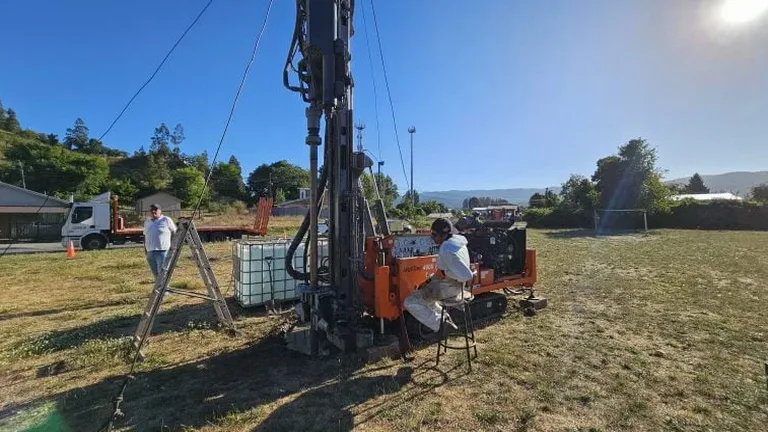
A commercial development off Lima Road hit unexpected fill at 4 feet. The original geophysical survey missed it entirely. Two exploratory test pits solved the uncertainty in under three hours. Fort Wayne sits on a complex sequence of glacial tills and outwash deposits—the Trappist till overlying the older Lagro formation in many areas. Hand augers won't cut through the dense clay, and drill rigs are overkill for shallow foundations. We use a compact excavator to open clean vertical faces down to 10–12 feet. The exposed profile tells you everything: stratification, moisture, oxidation mottling, and any buried organics. For deeper bearing verification we combine the test pit with SPT drilling when the foundation design requires N-values below the weathered zone. Each pit gets logged on-site, photographed with scale, and sampled immediately before the walls dry out. You get a stratigraphic column and a field report that afternoon.
A 45-minute test pit can replace three days of speculation about shallow fill, organics, or buried topsoil beneath a building pad.
Our approach and scope
Local geotechnical context
Shallow utilities are the number one hazard in urban Fort Wayne test pit work. Gas laterals, fiber optic lines, and old clay sewer pipes often sit just 18–24 inches below grade in older neighborhoods like West Central or Southwood Park. We call Indiana 811 at least two full business days before mobilization. The locate ticket stays active on-site during excavation. In areas with known slag fill—common near the old rail corridors and industrial sites east of Downtown—we watch for abrupt changes in soil color and odor that signal contaminated material. Those pits get documented with extra photos and flagged for environmental review. The other risk is collapse in saturated sand lenses. After heavy rain, water seeps through the outwash and destabilizes pit walls within minutes. We keep a trench box on the truck and use it whenever conditions warrant. No one enters a pit deeper than 5 feet without shoring or benching. That isn't a guideline; it's standard practice and OSHA 1926 Subpart P compliance.
Reference standards
The work complies with ASTM D2488 for soil description and identification using visual-manual methods, and ASTM D420 for site characterization in accordance with engineering design and construction standards.
Complementary services
Standard Exploratory Test Pit
Single pit excavated to target depth, typically 6–10 feet. We log the profile, photograph each layer, measure moisture and consistency, and collect representative samples. Includes a one-page field report with stratigraphic column and site plan showing pit location. Ideal for footing inspections, shallow utility routing, and verifying fill thickness.
Test Pit with Laboratory Package
Everything in the standard pit plus a coordinated lab program. We extract undisturbed block samples from cohesive layers and disturbed samples from granular zones. Testing typically includes moisture content, grain size distribution, Atterberg limits, and organic content. Results are compiled into a geotechnical data report with classification charts and recommendations for bearing capacity presumptive values per IBC Table 1806.2.
Typical parameters
Quick answers
How deep can you dig an exploratory test pit in Fort Wayne?
With a compact excavator we reach 10–12 feet in good conditions. The practical limit depends on the soil type and groundwater. In the tight glacial till common across Allen County, vertical walls stay stable deeper than in sandy outwash. If you need information below 12 feet, we typically recommend switching to SPT drilling.
How much does an exploratory test pit cost in Fort Wayne?
How long before I get results from the test pit?
You receive the field log and photos the same day we dig, usually by email before 5 PM. If lab testing is part of the scope, the complete geotechnical report with classification data and recommendations takes 48–72 hours after sample delivery to the lab.
Do I need a locate ticket before you mobilize?
Yes. We handle the Indiana 811 request as part of our mobilization procedure. We need a minimum of two full business days between the locate request and excavation. The ticket must cover the exact dig area plus a reasonable buffer.
Can you dig test pits in winter?
It is possible but slower. Frozen ground in the top 12–18 inches requires extra breakout force. We schedule winter pits on a case-by-case basis and only when the frost layer is manageable with available equipment. Most clients prefer to plan exploratory work between April and November.