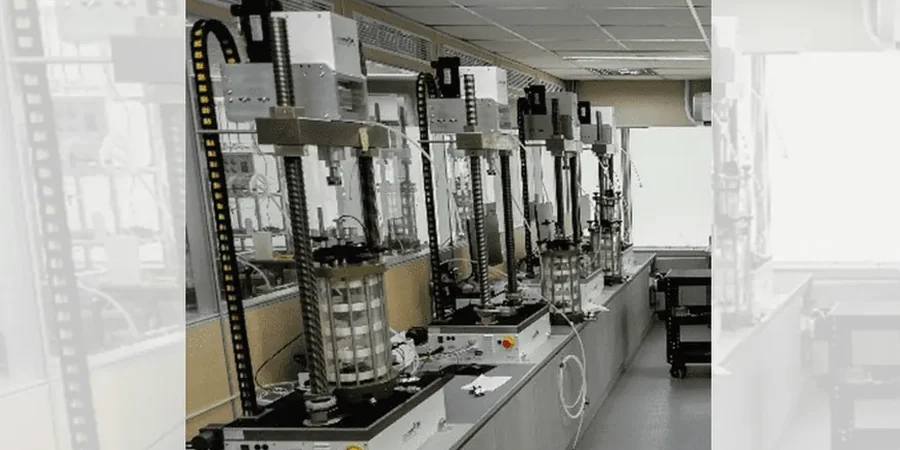
A six-story mixed-use project on the old industrial corridor near the St. Marys River hit a layer of saturated silty clay at 18 feet. The general contractor needed bearing capacity numbers that accounted for pore pressure buildup under the building’s footprint, not just generic presumptive values from the county soil survey. The Fort Wayne area sits on thick sequences of Wisconsinan glacial till and lacustrine deposits, where drained and undrained behavior can diverge significantly. A standard unconfined compression test would miss the effective stress story entirely. We ran a consolidated-undrained triaxial series with pore pressure measurement on Shelby tube samples from that depth: three confining pressures, back-pressure saturation per ASTM D4767, and strain-controlled loading at 0.5% per minute. The Mohr-Coulomb envelope gave c' and phi' values that allowed the structural engineer to reduce the footing width by 14 inches, saving concrete without sacrificing the factor of safety. When glacial soils control the design, the triaxial cell is where the real conversation between the geotech and the structural team begins. For projects where shallow refusal is expected, we often pair the triaxial program with SPT drilling to correlate lab-derived strength with in-situ N-values across the site.
Effective stress parameters from a triaxial cell are worth more than a hundred index tests when you are designing below the water table.
Our approach and scope
Local geotechnical context
The biggest triaxial-related failure we see in Fort Wayne reports is using total-stress parameters from unconsolidated-undrained tests for a long-term condition where the clay will eventually drain. A basement excavation near the Maumee River stays open for six months: the clays relax, negative pore pressures dissipate, and the effective stress drops. If the wall design used UU phi-equal-zero without checking drained strength, you get cracks. Another pattern is testing only one confining pressure: you cannot construct a Mohr-Coulomb envelope from a single circle, yet we review reports that do exactly that, then assign a friction angle from a textbook table. Glacial tills with fissures or sand partings also fail along pre-existing planes that a triaxial specimen may not capture if the sample is trimmed from intact material between defects. We address this by requiring detailed boring logs, noting fissure frequency and oxidation, and comparing triaxial phi' with back-calculated values from CPT pore pressure dissipation tests when available.
Reference standards
Triaxial tests are conducted per ASTM D4767-11 (consolidated undrained with pore pressure measurement), ASTM D7181-20 (consolidated drained), AASHTO T-297, and USACE EM 1110-2-1906 for interpretation of shear strength.
Complementary services
Consolidated-Undrained Triaxial with Pore Pressure (CU)
Three-stage or multi-specimen CU testing for effective stress strength envelope. Includes back-pressure saturation, B-check, and strain-controlled shear with pore pressure measurement. Delivers c', phi', and Skempton's A at failure for short-term and long-term analysis.
Consolidated-Drained Triaxial (CD)
Slow shear rate testing for free-draining soils or long-term clay stability. Direct measurement of drained friction angle without pore pressure correction. Required for slope stability modeling where steady-state seepage controls the failure surface.
Typical parameters
Quick answers
What is the typical turnaround time for a triaxial test program in Fort Wayne?
A three-specimen CU series with pore pressure measurement takes 10 to 14 calendar days from sample delivery to final report, assuming the samples arrive intact and saturation proceeds without delays. Drained tests on low-permeability glacial clays can extend to three weeks because each specimen may require 48 to 72 hours of shear time alone.
Can you test silty sand from a Fort Wayne site, or is triaxial only for clays?
Triaxial testing works for both cohesive and cohesionless soils. For silty sands from the outwash deposits common in Allen County, we run consolidated-drained tests on remolded specimens compacted to field density. The effective friction angle we measure feeds directly into bearing capacity and slope stability calculations.
How much does triaxial testing cost?
What B-value do you accept before starting the shear stage?
Per ASTM D4767, we require a minimum B-value of 0.95. For stiff glacial clays with occluded gas, reaching 0.95 may require back pressures above 80 psi over several days. We do not begin shearing until the B-check passes; otherwise the measured pore pressure during shear is unreliable, and the effective stress path is meaningless.
How do I know whether I need CU or CD triaxial testing for my Fort Wayne project?
CU with pore pressure covers most situations: the effective stress parameters work for long-term drained analysis, and the total-stress envelope works for end-of-construction short-term checks. CD testing becomes necessary when you are modeling long-term slope stability in stiff fissured clays where the failure occurs slowly enough that pore pressures have fully equalized. We review your boring logs and design load cases and recommend the appropriate drainage condition.