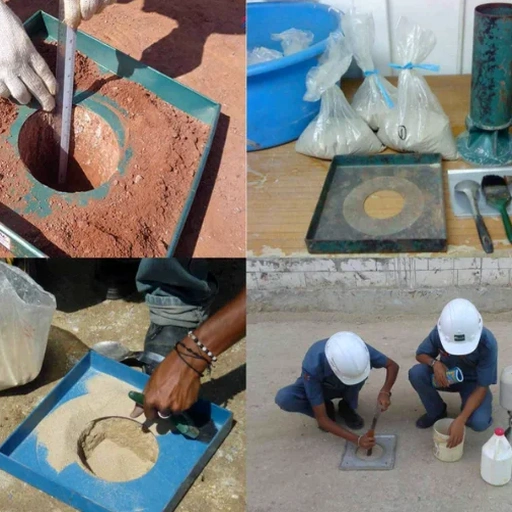
Contractors in Fort Wayne know that the Maumee River floodplain deposits can make subgrade preparation unpredictable, especially after a wet spring season. A visual check of the lift thickness is never enough when the underlying glacial till shows variable drainage characteristics from one lot to the next. We perform the sand cone density test because it delivers a direct measurement of in-place density that a nuclear gauge cannot always resolve in the silty clay mixtures common across Allen County. The procedure follows AASHTO T 191 and ASTM D1556, giving you a defensible number for the compaction spec. For projects where the structural fill extends deeper than five feet, the data pairs naturally with a Proctor curve to establish the relative compaction percentage, and when the subgrade shows excessive moisture we often coordinate with a grain size analysis to confirm whether the fines content is driving the problem. The goal is straightforward: deliver a test report within 24 hours so the earthwork crew stays moving and the project engineer has documentation ready for the municipal inspector.
A sand cone test gives you the one number that matters for compaction payment: verified dry density against the Proctor maximum, without correction factors.
Our approach and scope
Local geotechnical context
The most expensive mistake we see in Fort Wayne earthwork projects is accepting density test results from a nuclear gauge that was never correlated to a sand cone on the specific site soil, particularly in the clay-rich tills east of I-69 where bound water in the clay matrix shifts the neutron moisture reading by several percentage points. When the compaction report looks compliant but the fill settles six months after paving, the cost to saw-cut, remove, and reconstruct a failed pavement section dwarfs the original testing budget. Another recurring issue involves testing too shallow: a 3-inch hole in a 12-inch lift only characterizes the upper portion, leaving the bottom half unverified, which is why the standard requires the hole depth to match the lift thickness. The sand cone method avoids both pitfalls because it measures the entire lift and does not rely on source decay corrections or daily standardization against a block that may not represent the site material. In utility trenches where the backfill must achieve 95 percent of standard Proctor density to satisfy City of Fort Wayne utility permit conditions, skipping a density test can trigger a stop-work order and a requirement to re-compact at the contractor’s expense.
Reference standards
ASTM D1556-15e1 – Standard Test Method for Density of Soil In Place by the Sand-Cone Method, AASHTO T 191-14 – Standard Method of Test for Density of Soil In-Place by the Sand-Cone Method, ASTM D698-12e2 – Standard Proctor (laboratory compaction reference), ASTM C778-17 – Standard Specification for Standard Sand (Ottawa sand for calibration), ISO/IEC 17025:2017 – General requirements for the competence of testing and calibration laboratories
Complementary services
Subgrade and Fill Compaction Testing
Sand cone density tests performed on prepared subgrade, structural fill lifts, and building pad areas, with relative compaction reported against the laboratory standard Proctor curve. We coordinate sampling logistics so the crew never waits on test results.
Utility Trench Backfill Verification
Density testing within trench zones for water, sewer, and storm drainage lines, following the City of Fort Wayne Public Works compaction requirements. Tests are located at the pipe zone, haunch, and upper fill layers to document compliance throughout the backfill profile.
Nuclear Gauge Correlation Studies
On large earthwork projects where a nuclear gauge is used for production control, we establish the site-specific correlation between the gauge readings and sand cone reference values at multiple density and moisture levels, satisfying ASTM D6938 requirements for method calibration.
Compaction Troubleshooting and Retesting
When failing density tests occur, we help identify the root cause—excess moisture, oversized particles, or insufficient compactive effort—and supply retesting after corrective reworking to keep the project on schedule without sacrificing documentation quality.
Typical parameters
Quick answers
How much does a sand cone density test cost in Fort Wayne?
A single field density test with the sand cone method typically runs between US$110 and US$150 per point, depending on the number of tests scheduled per mobilization and the travel distance within Allen County. Projects with five or more test locations on the same day usually fall toward the lower end of that range.
How soon can we get density test results on site?
The field wet density and hole volume are calculated immediately on site, so the crew knows within minutes whether the lift passes the density requirement. The final report with laboratory moisture content, dry density, and relative compaction percentage is typically issued within 24 hours, which aligns with most municipal inspection workflows in Fort Wayne.
Can the sand cone method be used in granular soils with gravel?
Yes, as long as the maximum particle size does not exceed 1.5 inches for the standard 6.5-inch diameter cone apparatus. For soils containing larger cobbles, a larger test pit volume and alternative methods such as the rubber balloon test may be more appropriate, but the sand cone remains the reference method specified in most Indiana earthwork specifications for soils with gravel content below the threshold.
How many density tests are required for a building pad in Allen County?
The number of tests depends on the pad area and the governing specification, but a common rule of thumb is one test per 2,500 square feet per lift. For a typical 3,000-square-foot residential pad compacted in three lifts, that translates to roughly four to six sand cone tests distributed across the area, with additional tests focused on zones that showed soft spots during proof-rolling.
Does the sand cone test work in saturated soils?
The reference range for this service in Fort Wayne is US$110 - US$150. The final price depends on the project scope and volume.